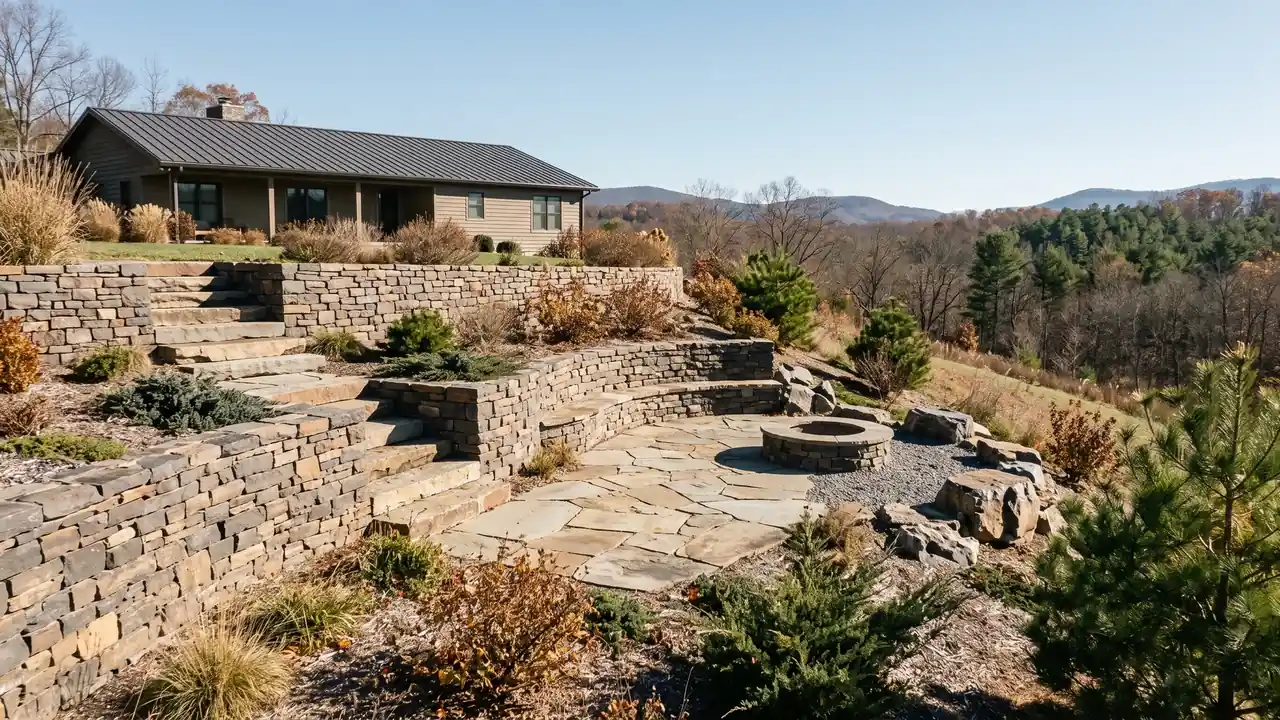
Retaining wall contractors in Rocky Mount, VA build walls that hold back soil so a sloped Franklin County lot can have a level patio, driveway edge or lawn. The County's guideline describes an exemption for walls supporting less than three feet of ordinary unbalanced fill, with exceptions for surcharges. This site is not the builder; it is a request service that names any local provider before you agree.
Retaining-wall planning in Rocky Mount, Virginia is for homeowners who need to support grade, protect access, or create usable ground without reducing the wall to a row of visible blocks. The goal is a request that shows the entire slope, nearby loads, drainage clues, and the purpose above and below the wall. This site is an independent project-request service, not a contractor.
What does a Rocky Mount retaining wall contractor build?
A retaining wall is a system that resists soil pressure while giving water a controlled route. Planning starts with retained height, wall length, ground slope at the top and toe, structures or driveways nearby, and the intended use of each side. Excavation, foundation preparation, drainage aggregate, backfill, compaction, reinforcement where required, finish material, and safe transitions all depend on that context.
A garden border that holds little grade is not the same problem as a wall supporting a patio, driveway, steep slope, or surcharge. Curves, corners, stairs, utilities, property lines, and limited access also affect the system. Product details cannot replace site-specific design where the height, loading, soil, or code calls for professional review.
When does a yard need retaining rather than simple grading?
A wall becomes relevant when a safe, stable slope would consume the area needed for a patio, route, planting bed, or yard. It may also replace a failing wall that leans, bulges, rotates, separates, or sheds soil. Erosion at the toe, persistent wetness, displaced units, and new cracks are observations worth documenting, not diagnoses to make from a webpage.
If the wall’s purpose is to create a gathering area, compare the sequencing in retaining wall or patio first. If movement is paired with seepage or washout, use the retaining-wall drainage guide to collect better observations before seeking an onsite assessment.
Why are full-slope context and local ground important?
The pressure on a wall comes from more than the soil visible directly behind its face. Water, sloping backfill, parked vehicles, structures, fences, trees, and construction activity can change the load. Rocky Mount sits within varied Piedmont terrain, so one lot may expose weathered soil while another encounters fill or rock. Parcel mapping is a screening tool; actual conditions must be checked where the wall will stand.
Franklin County’s retaining-wall guideline, checked October 9, 2026, asks permit plans to show actual ground slope at the top and toe, bearing capacity, drainage method, wall elevations, cross sections, material specifications, and backfill compaction. That list is useful even before a permit decision because it shows why a face-only photograph cannot describe the work.
What affects retaining-wall cost?
Retained height, length, loading, soil, excavation, disposal, imported aggregate, drainage, reinforcement, finish material, corners, curves, steps, and access all affect scope. A wall near a driveway or structure demands different questions from a low landscape edge. Hand-carried materials and restricted equipment routes can change labor even when two walls have similar dimensions.
Design review, permits, inspections, erosion controls, property-line coordination, and repair of disturbed surfaces may also be part of the project. The useful output above or below the wall matters: a patio, walkway, stair landing, or level yard adds its own preparation and drainage. A responsible request should describe that destination rather than asking for a price per visible wall area.
Can a retaining wall be repaired, or should it be rebuilt?
A loose cap, isolated surface damage, or a small washed joint may be repairable when the wall remains aligned and its support system is sound. Rebuilding becomes more likely when broad sections lean or bulge, the base has moved, drainage cannot be restored without excavation, or the existing wall was not suited to its loading. Covering a structural symptom with new facing does not correct the cause.
Do not excavate beside a moving wall or stand where displaced soil or units could fall. Photograph changes from a safe location and compare dated views. The party evaluating the site should determine whether immediate precautions, engineered design, or staged removal are needed.
How should you prepare a retaining-wall request?
Measure approximate wall length and the exposed height at several points without climbing or digging. Take wide photos from the top, bottom, both ends, and far enough away to show the complete grade. Include nearby buildings, pavement, fences, utilities you know about, trees, downspouts, and the route equipment might use. Describe when wetness or movement appears and what the area should become.
Franklin County’s published thresholds belong in the local permits guide, but the short version is to confirm both Town zoning and County building requirements before work. The County guideline says the exemption for less than three feet of unbalanced fill does not apply to every loading condition. Contact Virginia 811 before excavation and wait for responses.
For an existing wall, create a short timeline from dated photographs, prior repairs, and changes in drainage or loading. Note whether movement appeared suddenly or accumulated over seasons without guessing at the cause. For a new wall, sketch the desired wall line and the usable dimensions it should create. Include property survey information when available and identify uncertain boundaries plainly. Ask who will be responsible for design, permit documents, inspections, drainage outlets, and restoration before accepting a scope. Those responsibilities can span more than one party, and the request should expose gaps early rather than leaving them to be discovered after excavation.
Requests come from the Town of Rocky Mount and from Franklin County communities around it: Boones Mill, Ferrum, Callaway, Burnt Chimney, Wirtz, Glade Hill, Union Hall, Penhook and the Westlake side of Smith Mountain Lake. Town and County rules differ, so a provider is suggested only when one fits the job and location, and only by name with your OK.
Local rules and sources on this page were checked on October 9, 2026. Requirements change; confirm with the responsible office before work begins.
Decide the next part of your project
Use these guides to compare the work, prepare better questions and connect the service plan to the actual property.